How Virtual Trader Is Bringing AI to Intercompany Automation

A conversation on AI, agents, and the future of finance operations
We sat down with Nigel Molloy, Head of Product Development at Virtual Trader, to explore how AI is being embedded into intercompany processes. From intelligent assistants to agentic frameworks, Nigel shares how AI is delivering practical value today … and where it’s taking intercompany automation next.
Setting the Scene
What role is AI playing in Virtual Trader’s product strategy today?
Nigel Molloy:
“Firstly, I want to say that AI isn’t something we’ve bolted on after the fact; it’s becoming part of how we think about solving problems across the platform. Our focus has always been automation, but AI helps us go a step further. It allows us to make that automation more intelligent, more responsive, and ultimately more useful for finance teams.
“That said, we’re very deliberate in how we apply it. We’re not chasing novelty. Instead, we’re focused on practical outcomes: reducing manual effort, improving accuracy, and helping users navigate complex intercompany processes more efficiently.
“Intercompany is inherently complex. You’re dealing with high transaction volumes, multiple ERP systems, and strict compliance requirements. AI helps us cut through that complexity by making the system more intuitive and proactive, rather than just reactive.”
Making Data Accessible
How are you using AI to make data and documentation more accessible?
Nigel Molloy:
“One of the first areas we focused on was accessibility — specifically, how users interact with data and documentation. That’s where our desktop assistant comes in.
“It uses a Retrieval-Augmented Generation (RAG) approach, which essentially means users can ask questions in natural language and get answers grounded in both system data and supporting documents. So instead of digging through reports or manuals, you can simply ask, ‘why didn’t this transaction reconcile?‘ or ‘what’s the rule behind this posting?‘ and get a meaningful response.
“This has a real impact on day-to-day productivity. Finance teams no longer need to rely on tribal knowledge or escalate simple queries to support teams. They can self-serve, quickly and confidently.
“And because intercompany processes span multiple systems and datasets, this kind of contextual access becomes incredibly powerful. It turns the platform into something closer to a working partner, and not just a system of record.”
AI Is Only as Good as the Data
How important is data quality when introducing AI into finance processes?
Nigel Molloy:
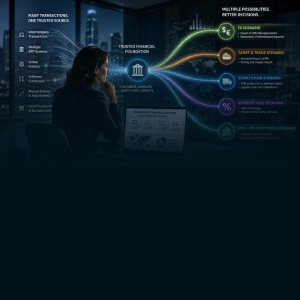
“It’s absolutely fundamental. AI can only make reliable decisions if the underlying data is accurate and consistent with a governed framework. In finance … especially intercompany accounting … poor-quality data creates risk very quickly.
“That’s why we’ve always focused heavily on structured transaction processing and standardized business rules across all of intercompany. AI works best when it operates within a controlled framework rather than on fragmented or inconsistent data.
“For us, the priority is making sure AI operates on trusted financial data with full auditability and traceability. That’s particularly important in areas like intercompany reconciliation, transfer pricing, and journal automation, where compliance and accuracy matter just as much as efficiency.
“In many ways, strong intercompany architecture is what makes more advanced AI capabilities possible in the first place.”
The Rise of Agentic AI
The agentic framework seems like a big step forward — what does it enable?
Nigel Molloy:
“Yes, this is probably the most exciting area for us right now! When we talk about “agentic AI,” we’re really talking about giving the system the ability to perform defined tasks independently. Within clear boundaries, of course.
“We’ve introduced a framework of seeded and configurable agents. Each agent can perform a specific job — for example, analyzing unmatched transactions, preparing adjustments, or initiating workflows. But the real power comes when you link those agents together.
“You can start to orchestrate more complex processes. One agent identifies an issue, another investigates it, and a third proposes a resolution. That’s where things move from automation to something closer to autonomy.
“Importantly, this doesn’t remove human oversight. Finance teams still approve outcomes, especially where financial or compliance risk is involved. But the heavy lifting — the repetitive, time-consuming work — is handled automatically.
“This is the foundation for where we’re going. Intercompany reconciliation, settlement, and workflow orchestration can all be built on top of this framework. And that’s where we see a real shift happening in finance operations.”
Smarter Journals, Less Manual Work
How is AI helping with manual journal processes?
Nigel Molloy:
“Manual journals are a great example of where AI can deliver immediate value without overstepping. We’re using AI to generate draft journal entries based on historical activity and patterns in the data. The system looks at how similar scenarios have been handled before and proposes a journal that aligns with those outcomes.
“But — and this is important — it’s still a draft. It goes to the user for review and approval. We’re not removing control; we’re accelerating the process.

“The benefit is consistency and speed. Instead of starting from scratch, users are reviewing something that’s already 80–90% complete. That reduces manual effort and helps standardize how transactions are handled across the organization.
“Given the volume and complexity of intercompany transactions, even small efficiency gains here can have a significant impact over time.”
AI Behind the Scenes
How is your team using AI internally to build the product?
Nigel Molloy:
“We’re also using AI extensively within our own development processes.
“It supports coding, testing, and quality assurance. For example, we use AI to help generate and validate code, identify edge cases, and accelerate testing cycles. That allows our team to focus more on design and problem-solving, rather than repetitive development tasks.
“The result is faster innovation. We can iterate more quickly, test ideas earlier, and bring new functionality to market with greater confidence.
“And because intercompany requirements evolve — whether due to regulatory changes or shifts in business models — that speed really matters. It allows us to stay aligned with what our customers need, rather than reacting after the fact.”
Looking Ahead
Where do you see AI taking intercompany automation next?
Nigel Molloy:
“We’re moving toward a more autonomous model, but in a controlled, practical way.
“The goal isn’t to replace finance teams; it’s to remove the friction from their workflows. Over time, we expect to see more end-to-end processes handled automatically, with users stepping in only where judgment or approval is required.
“That includes things like continuous reconciliation, intelligent exception handling, and automated settlement processes. These are areas where automation already exists — but AI allows us to make them more adaptive and context-aware.
“Ultimately, we’re aiming for a model where intercompany operations run in the background, with full transparency and control, but minimal manual intervention. Given the increasing complexity of global operations — from evolving tax rules to supply chain changes — that level of intelligence isn’t just nice to have. It’s becoming essential.”
From Automation to Autonomy
AI in finance isn’t a future concept – it’s already delivering tangible value. From intelligent assistants to AI-generated journals, Virtual Trader is embedding AI where it matters most: in the day-to-day realities of intercompany operations.
And with the introduction of the agentic framework, the direction is clear. This is about moving beyond automation toward truly intelligent workflows.
If you’d like to see how Virtual Trader’s AI capabilities can transform your intercompany processes, book a demo today.